The Lettered Quote Planner
Rule the lines in nib widths, count the lines a quote will take, and choose the nib that fits the frame, before the ink goes on good paper
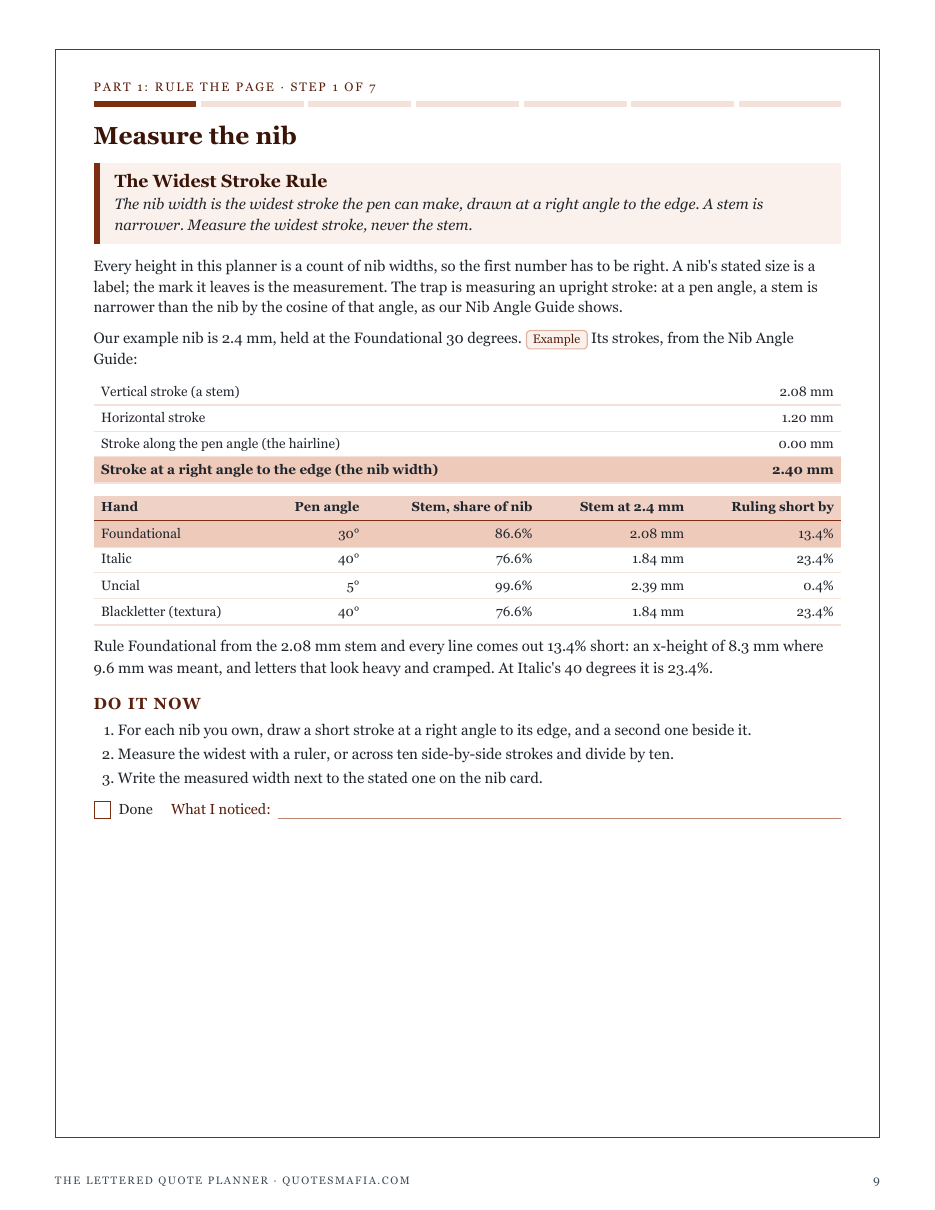
LetterForge's free tools each answer one question in their own unit. The Nib Angle Guide gives stroke widths in millimetres, the X-Height and Line Spacing Calculator works in pixels and a typeface's x-height ratio, and the Letter-Spacing Calculator converts tracking at a size in px but recommends it from a size in pt. None of them answers the question a letterer has before a quote goes on a sheet of good paper: how tall to rule for this nib, how many lines the words will take, and whether they will fit the frame. In a broad-edge hand that answer is counted in nib widths, a unit none of the tools uses. The Lettered Quote Planner joins them in seven steps. It measures the nib from its widest stroke (a stem at 30 degrees is 13.4% narrower, and guidelines ruled from it come out short), builds the heights from a ladder of nib widths, and rounds the line pitch up to the millimetre so rounding never eats the clearance. From one measured test line it works your letter pitch, wraps the quote by whole words (the worked 98-character example needs 7 lines where its length alone suggests 6), and chooses the largest nib whose block fits the frame: 2.4 mm on A4, where 3 mm needs 294 mm of a 225.7 mm space. It closes with a typeset proof at the lettered size in pt and px, with tracking worked in the right unit. Every figure is computed from the site's own calculators; the nib, test line and sheet are examples, and the hand proportions are common teaching values, labelled as such. It contains no quotations and no font files, and says plainly to check the words' copyright and each typeface's licence. It is for broad-edge hands; pointed and brush pens are covered from Step 4. Included: 24 printable pages with a nib and ruling card, a ruled Foundational sheet at actual size, a quote fitting sheet, a proof card, reference tables and a quickstart, plus a personalised sheet worked from the numbers you enter in the calculators.
Look inside
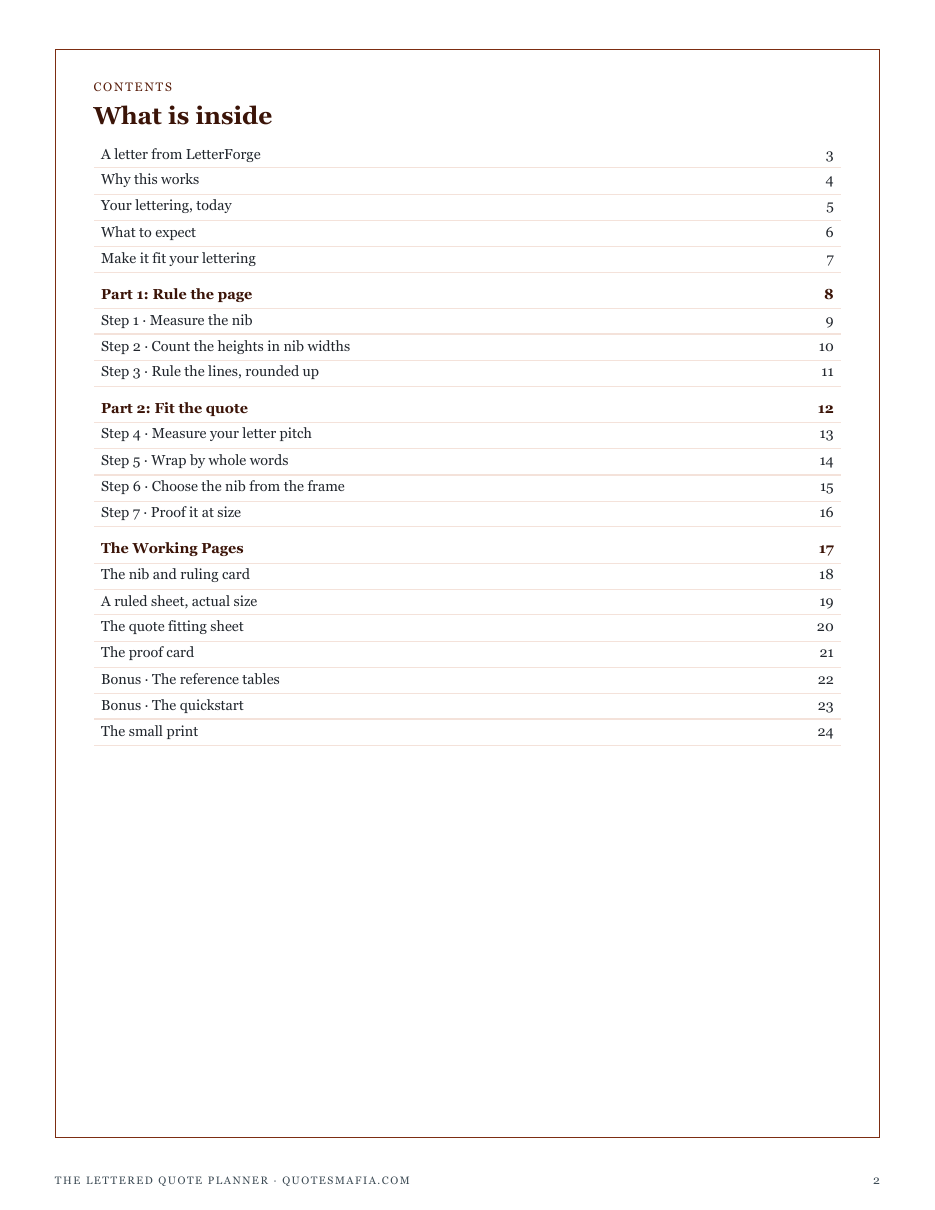
Two full pages from the planner, exactly as printed. Click either to read it at full size before you decide.
What is in it
- Step 1: measure the nib from its widest stroke, not the stem
- Step 2: heights in nib widths for Foundational, Italic, Uncial and blackletter
- Step 3: the line pitch, rounded up to the millimetre
- Step 4: your letter pitch from one measured test line
- Step 5: wrap the quote by whole words and count the lines
- Step 6: choose the largest nib whose block fits the frame
- Step 7: a typeset proof at the lettered size, in pt and px
- Working pages: nib and ruling card, ruled sheet at actual size, quote fitting sheet, proof card
- Reference tables: heights and pitches by hand and nib, characters and lines by sheet
- A personalised sheet worked from your nib, sizes and x-height ratio
- ✓ 24 printable pages
- ✓ 10 sections, worksheets and templates
- ✓ A second PDF worked out from the numbers you enter
- ✓ No account needed, just an email address
- ✓ Instant download; link valid 7 days
Price includes any taxes. Sold by GrabURL, who handle checkout and support. The charge appears on your statement as GrabURL.
The planner picks up where the free Nib Angle Guide leaves off. The guide gives the width of every stroke a broad nib makes; the planner turns that nib into ruled heights and a line pitch in nib widths, counts the lines a quote will take from one measured test line, chooses the nib that fits the frame, and converts the lettered size to points for a proof with the trackingworked in the right unit. It contains no quotations and no font files: check that the words you letter are yours to use, and each typeface's licence. It is for broad-edge hands; pointed pens and brush pens make their thick strokes from pressure and are covered only from Step 4 on.